最新版的NCP-MCI-6.10最新考古題,免費下載NCP-MCI-6.10學習資料得到妳想要的Nutanix證書
Wiki Article
順便提一下,可以從雲存儲中下載VCESoft NCP-MCI-6.10考試題庫的完整版:https://drive.google.com/open?id=1wYTBCUI5PwJM08wCHFD8dYKiNIy1ujiR
VCESoft 就是一個可以滿足很多參加 Nutanix 的 NCP-MCI-6.10 認證考試的IT人士的需求的網站,但是要想通過 NCP-MCI-6.10 考試還需要大家認真理解。即使是Nutanix 的 NCP-MCI-6.10 擬真試題和真實考試中的差不多,建議大家考試的時候,還是要把題看清楚,不能完全按照 NCP-MCI-6.10 擬真試題中的命令去做。要靈活運用,積極思考,不能死搬硬套。通過這個考試是需要豐富的知識和經驗的,而積累豐富的知識和經驗是需要時間的。
您是否感興趣想通過NCP-MCI-6.10考試,然后開始您的高薪工作?VCESoft擁有最新研發的題庫問題及答案,可以幫助數百萬的考生通過NCP-MCI-6.10考試并獲得認證。我們提供給您最高品質的Nutanix NCP-MCI-6.10題庫問題及答案,覆蓋面廣,可以幫助考生進行有效的考前學習。所有購買NCP-MCI-6.10題庫的客戶都將得到一年的免費升級服務,這讓您擁有充裕的時間來完成考試。我們會100%為您提供方便以及保障,請記住能讓您100%通過考試的題庫就是我們的Nutanix NCP-MCI-6.10考古題。
最有效的NCP-MCI-6.10最新考古題,免費下載NCP-MCI-6.10考試題庫得到妳想要的Nutanix證書
VCESoft是一個專門提供IT認證考試資料的網站,它的考試資料通過率達到100%,這也是大多數考生願意相信VCESoft網站的原因之一,VCESoft網站一直很關注廣大考生的需求,以最大的能力在滿足考生們的需要,VCESoft Nutanix的NCP-MCI-6.10考試培訓資料是一個空前絕後的IT認證培訓資料,有了它,你將來的的職業生涯將風雨無阻。
Nutanix NCP-MCI-6.10 考試大綱:
| 主題 | 簡介 |
|---|---|
| 主題 1 |
|
| 主題 2 |
|
| 主題 3 |
|
| 主題 4 |
|
| 主題 5 |
|
最新的 NCM-MCI NCP-MCI-6.10 免費考試真題 (Q97-Q102):
問題 #97
A security team asks an administrator toset up port mirroringof aspecific source VMto atarget VM.
What must the administrator ensure for this configuration to be possible?
- A. Source VM and Target VM are on the same host.
- B. Source VM and Target VM are on the same VLAN.
- C. Source VM and Target VM are on the same VPC.
- D. Source VM and Target VM are on the same subnet.
答案:A
解題說明:
Port mirroring requires the source and target VMs to be on the same host to efficiently copy network traffic without additional routing overhead.
* Option B (Source VM and Target VM are on the same host) is correct:
* AHV's port mirroringonly works within a single hostbecause network packets are intercepted before leaving the hypervisor.
* If the VMs are on different hosts,mirroring cannot be configured without additional network tools.
* Option A (Same VLAN) is incorrect:
* VLAN membership isnot a requirementfor port mirroring.
* Option C (Same subnet) is incorrect:
* Port mirroring happens atthe virtual switch level, which does not require VMs to be in the same subnet.
* Option D (Same VPC) is incorrect:
* While VPCs provide network isolation,they do not control port mirroring availability.
References:
* Nutanix AHV Networking Guide #Configuring Port Mirroring in AHV
* Nutanix KB #Port Mirroring Best Practices
問題 #98
Which task should be performed first when upgrading host memory?
- A. Remove node from the cluster.
- B. Execute "shutdown -h now" from the AHV command line interface.
- C. Gracefully stop the host by using the out of band management interface.
- D. Place node into the maintenance mode
答案:D
解題說明:
The Nutanix ECA course provides detailed procedures for performing hardware upgrades, such as adding host memory, to ensure cluster stability and data availability. Upgrading host memory requires safely preparing the node to avoid disrupting running VMs or cluster operations.
Extract from Nutanix Enterprise Cloud Administration (ECA) Course Documents:
* Module: Cluster Management, Section: Hardware Upgrades"Before performing hardware upgrades, such as adding host memory, the node must be placed into maintenance mode. This ensures that all VMs are migrated to other nodes and the host is safely isolated from cluster operations."
* Module: Host Maintenance, Section: Maintenance Mode"Placing a node into maintenance mode is the first step for hardware upgrades. Maintenance mode migrates all VMs to other nodes, stops the Controller VM (CVM), and prepares the host for safe shutdown or hardware changes." Explanation of Options:
* A. Gracefully stop the host by using the out of band management interfaceThis is incorrect. Stopping the host via the out-of-band management interface (e.g., IPMI or iLO) without first entering maintenance mode risks disrupting running VMs and cluster services. The ECA course warns:"Shutting down a host without maintenance mode can cause VM crashes and data unavailability, as VMs are not migrated."
* B. Remove node from the clusterThis is incorrect. Removing a node from the cluster is a permanent action that detaches it from the cluster's metadata and storage pool, requiring re-imaging to rejoin. It is not appropriate for a temporary hardware upgrade like adding memory. The ECA course states:" Removing a node is not required for hardware upgrades and should be avoided, as it disrupts cluster configuration."
* C. Execute "shutdown -h now" from the AHV command line interfaceThis is incorrect. Running shutdown -h now on the AHV host without entering maintenance mode will abruptly stop the host, potentially crashing VMs and disrupting cluster operations. The ECA course notes:"Directly shutting down a host via CLI without maintenance mode risks data loss and service disruption."
* D. Place node into maintenance modeThis is the correct answer. Placing the node into maintenance mode is the first step for hardware upgrades, as it safely migrates all VMs to other nodes, stops the CVM, and prepares the host for shutdown or hardware changes. The ECA course emphasizes that maintenance mode ensures cluster stability during upgrades.
* Supporting Extract:"To upgrade host memory, place the node into maintenance mode using Prism Element or the CLI command ncli host maintenance_mode. This ensures safe VM migration and host isolation." Additional Context from ECA:
* Maintenance Mode Process: In Prism Element, maintenance mode can be enabled underHardware > Host > Enter Maintenance Mode. The process automatically migrates VMs using live migration, stops the CVM, and isolates the host. For AHV, the CLI command is ncli host maintenance_mode id=<host_id> enable=true.
* Memory Upgrade: After entering maintenance mode, the host can be safely powered off to add memory, then powered back on and exited from maintenance mode.
Supporting Reference from Web Results:
The Nutanix Bible (https://www.nutanix.com/go/the-nutanix-bible) confirms:"Maintenance mode is the required first step for host hardware upgrades, ensuring VMs are migrated and the node is isolated before changes like memory upgrades."
問題 #99
An administratorwants to ensure that VMscan bemigrated and restarted on another nodein the event of a single-host failure.
What action should be taken in Prism Element to meet this requirement?
- A. EnableHA Reservation.
- B. SetRedundancy Factor to 3.
- C. Configure aProtection Domain.
- D. Configure anRF1 storage container.
答案:A
解題說明:
To ensureVM high availability (HA) in the event of a node failure, the administrator mustenable HA Reservation (Option B)in Prism Element.
* High Availability (HA) in Nutanix ensures that VMs restart on another available node if the host they are running on fails.
* Option A (Redundancy Factor 3)affectsstorage redundancy, not VM failover.
* Option C (Protection Domains)is related todisaster recovery (DR), not local HA failover.
* Option D (RF1 Storage Container)would reduce fault tolerance and is not recommended for production environments.
References:
* Nutanix Prism Element Guide #Configuring HA Reservation
* Nutanix Bible #High Availability (HA) and Failover
* Nutanix Support KB #VM Recovery with HA Enabled
問題 #100
Which Nutanix feature predicts future resource utilization and capacity needs?
- A. Nutanix Move
- B. Xi IoT
- C. Prism Pro Capacity Planning
- D. Nutanix Beam
答案:C
問題 #101
A consultant is configuringsyslog monitoringand wants to receiveCRITICAL logsfrom theAudit module.
Which severity level setting should be configured to get the desired output?
- A. 0
- B. 1
- C. 2
- D. 3
答案:A
解題說明:
Syslog severity levels follow a standard numerical system, wherelower numbers indicate higher severity.
Option B (Severity Level 2) is correct:
Level 2 = CRITICAL# Used forserious conditions requiring immediate attention.
Audit logs often generate Critical logsrelated tosecurity, access violations, or major failures.
A screenshot of a computer Description automatically generated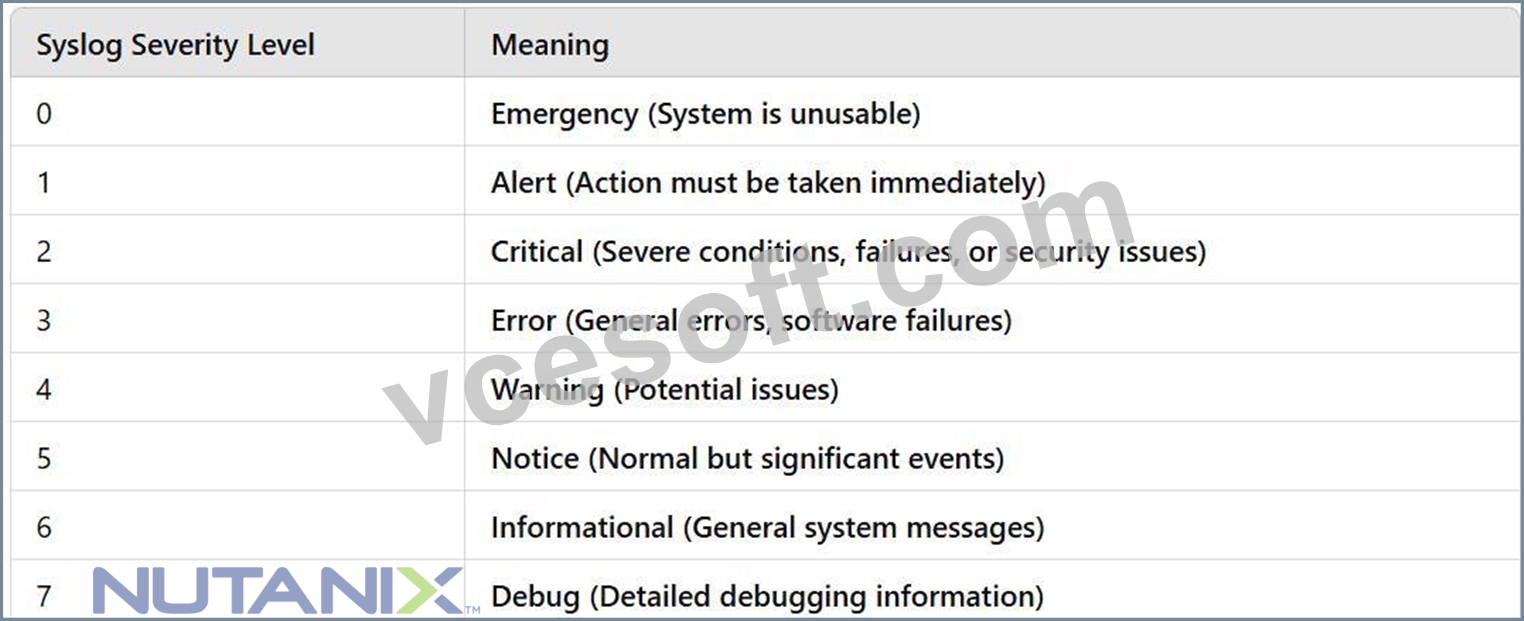
Options A (0), C (5), and D (7) are incorrect:
0 = Emergency (Too severe, only used for full system failures).
5 = Notice (Not critical, used for general system events).
7 = Debug (Not relevant for critical logs).
References:
Nutanix Security Guide#Syslog Integration and Severity Levels
Nutanix KB#Configuring Syslog for Prism Central Audit Logs
問題 #102
......
Nutanix的NCP-MCI-6.10認證考試是現在IT領域非常有人氣的考試。取得這個考試的認證資格對想晉升的人們來說是最好的,也是最可以看到效果的選擇。而且,借助這個考試你也可以提高自己的技能,掌握更多的對工作有用的技術。這樣你就可以更好地完成你的工作,向別人展示你的超強的能力。也只有这样你才可以获得更多的发展机会。
NCP-MCI-6.10考試備考經驗: https://www.vcesoft.com/NCP-MCI-6.10-pdf.html
- NCP-MCI-6.10題庫更新 ???? NCP-MCI-6.10考題資訊 ???? NCP-MCI-6.10證照信息 ???? ⏩ www.newdumpspdf.com ⏪上搜索⏩ NCP-MCI-6.10 ⏪輕鬆獲取免費下載NCP-MCI-6.10更新
- NCP-MCI-6.10通過考試 ???? NCP-MCI-6.10最新考古題 ???? NCP-MCI-6.10更新 ???? 請在( www.newdumpspdf.com )網站上免費下載【 NCP-MCI-6.10 】題庫NCP-MCI-6.10考試資料
- NCP-MCI-6.10更新 ???? 新版NCP-MCI-6.10考古題 ???? NCP-MCI-6.10最新考古題 ???? 到➡ www.pdfexamdumps.com ️⬅️搜尋▶ NCP-MCI-6.10 ◀以獲取免費下載考試資料NCP-MCI-6.10最新考題
- 完美的NCP-MCI-6.10最新考古題和資格考試中的領先提供商和無與倫比的NCP-MCI-6.10考試備考經驗 ???? ( www.newdumpspdf.com )上的“ NCP-MCI-6.10 ”免費下載只需搜尋NCP-MCI-6.10考試內容
- NCP-MCI-6.10題庫更新 ???? NCP-MCI-6.10證照資訊 ???? NCP-MCI-6.10最新考古題 ???? 立即在( tw.fast2test.com )上搜尋“ NCP-MCI-6.10 ”並免費下載NCP-MCI-6.10最新考題
- NCP-MCI-6.10更新 ???? NCP-MCI-6.10熱門考題 ???? NCP-MCI-6.10題庫更新 ???? ( www.newdumpspdf.com )網站搜索▛ NCP-MCI-6.10 ▟並免費下載NCP-MCI-6.10最新考題
- 高質量的NCP-MCI-6.10最新考古題,全面覆蓋NCP-MCI-6.10考試知識點 ???? 在➠ tw.fast2test.com ????網站上免費搜索⮆ NCP-MCI-6.10 ⮄題庫NCP-MCI-6.10題庫下載
- NCP-MCI-6.10考古題更新 ???? NCP-MCI-6.10資訊 ☮ NCP-MCI-6.10考試內容 ???? 在⏩ www.newdumpspdf.com ⏪網站下載免費▶ NCP-MCI-6.10 ◀題庫收集NCP-MCI-6.10資訊
- NCP-MCI-6.10資訊 ???? NCP-MCI-6.10題庫更新 ???? NCP-MCI-6.10熱門考題 ???? 到( www.pdfexamdumps.com )搜尋➠ NCP-MCI-6.10 ????以獲取免費下載考試資料NCP-MCI-6.10考試資料
- 最新版的NCP-MCI-6.10最新考古題,免費下載NCP-MCI-6.10學習資料幫助妳通過NCP-MCI-6.10考試 ???? 立即在➤ www.newdumpspdf.com ⮘上搜尋➥ NCP-MCI-6.10 ????並免費下載NCP-MCI-6.10考古題更新
- 準備充分的NCP-MCI-6.10最新考古題和資格考試中的領先提供者和更新的Nutanix Nutanix Certified Professional - Multicloud Infrastructure (NCP-MCI v6.10) ???? 透過▶ tw.fast2test.com ◀輕鬆獲取【 NCP-MCI-6.10 】免費下載NCP-MCI-6.10學習筆記
- karimygxu230663.thenerdsblog.com, honeymqdq539490.wikiannouncing.com, saadnlov658483.wikisona.com, rebeccabwbe491934.blogoxo.com, caraeckk360657.verybigblog.com, alyshabaxx804762.buscawiki.com, socialrus.com, bookmarks4seo.com, elijahrbff704374.anchor-blog.com, thebookmarklist.com, Disposable vapes
順便提一下,可以從雲存儲中下載VCESoft NCP-MCI-6.10考試題庫的完整版:https://drive.google.com/open?id=1wYTBCUI5PwJM08wCHFD8dYKiNIy1ujiR
Report this wiki page